> For the complete documentation index, see [llms.txt](https://guides.paynow.gg/llms.txt). Markdown versions of documentation pages are available by appending `.md` to page URLs; this page is available as [Markdown](https://guides.paynow.gg/store/settings.md).
# Settings
## Store Settings
The "General" section allows you to configure and customize your store's details, platform preferences, and integration methods. Below is a breakdown of the fields and their purposes:
### Store Details
* **ID**: This is a unique identifier for your store, used when integrating with the PayNow API.
* **Name**: The name of your store as it appears on your webstore, checkout pages, and payment descriptors. Make sure this is clear and recognizable to your customers.
* **Slug**: This field allows you to define a URL-friendly name for your store, which is used for identifying your store in web URLs.
### Platform
* **Platform**: Choose your platform from the dropdown menu. Selecting the appropriate platform (e.g., Rust) ensures the features are optimized for your store’s needs.
### Support
* **Support Email**: Provide an email address that your customers can use to contact your support team.
* **Contact Email**: Specify an email address that PayNow can use to reach out to you for store-related communication. This can differ from the Support Email if necessary.
### Integration
* **Integration Type**: Select how you want to integrate PayNow into your store. Current options include:
* **Hosted Webstore**: Ideal if you are using PayNow's hosted solution for your store.
* **Headless API**: Choose this option for a fully customizable integration using PayNow’s API.
* **Third-Party Integration**: Select this if you are using a third-party platform to integrate PayNow into your store.
***
### Payment Settings
In Payment Settings, you can control global payment options for your store, including showing all payment methods for subscriptions and enabling store-wide tax-inclusive pricing.
#### Adaptive Currency
Adaptive Currency lets your customers see prices and pay in their local currency, while PayNow absorbs the foreign exchange risk. It's enabled by default on every store and included at no additional cost.
Two controls are available here:
* **Enable Adaptive Currency** – the master toggle for the feature.
* **Show Adaptive Currency on storefront** – controls whether customers see their local currency on your storefront by default. When off, storefront prices stay in your base currency but customers can still switch at checkout.
For full details, supported regions, and how it affects custom storefronts, see the Adaptive Currency guide.
***
### Payment Restrictions
Payment Restrictions let you limit how certain card types can be used on your store.
#### Prepaid Card Restrictions
Prepaid cards are a common source of fraud, trial abuse, and subscription churn since they can be disposable and run out of funds mid-billing-cycle. This setting controls whether customers can check out with a prepaid card.
Three options are available:
* **Accept all prepaid cards** – Prepaid cards are allowed for every purchase.
* **Block for trial periods only** – Customers cannot start a trial using a prepaid card. Regular one-time purchases and subscriptions are still allowed.
* **Block for all subscriptions** – Prepaid cards cannot be used for any subscription, including trials and regular recurring plans. One-time purchases are still allowed.
{% hint style="info" %}
**Block for all subscriptions** is the most common choice for stores that offer recurring products, since it prevents churn from expired prepaid balances while keeping one-time purchases frictionless.
{% endhint %}
### Checkout Settings
Checkout Settings control how customers can combine discounts at checkout.
#### Promo Code Stacking Behavior
Choose how coupons and gift cards interact when a customer applies more than one at checkout.
Three options are available:
* **Disable stacking** – Only one promo can be applied at checkout. Customers cannot combine multiple gift cards or coupons.
* **Gift Card stacking only** – Customers can apply multiple gift cards to the same order, but coupons cannot be combined — not with other coupons, and not with gift cards.
* **Enable stacking** – Customers can combine multiple coupons and gift cards on the same order.
{% hint style="info" %}
**Gift Card stacking only** is a good middle ground — customers can redeem gift card balances across multiple cards in one purchase, while your coupon discounts stay predictable.
{% endhint %}
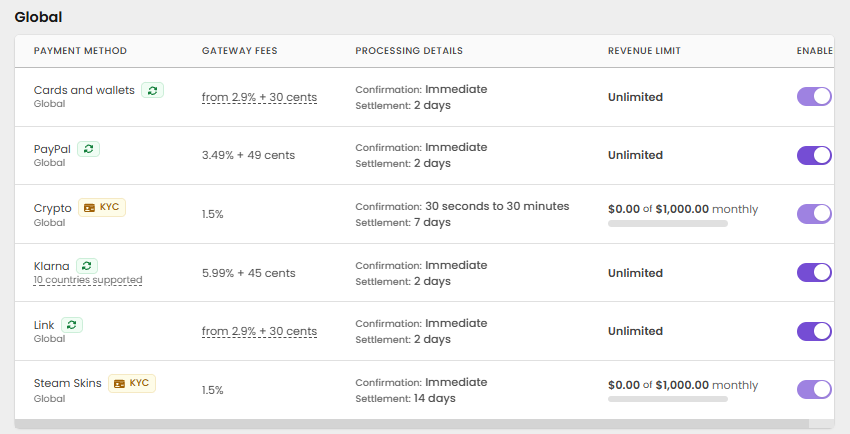
### **Payment Methods**
The Payment Methods section allows you to manage various payment options for your store. Payment methods are organized into Global and regional tabs.
{% hint style="info" %}
Your store can offer regional payment methods regardless of its base currency — including Klarna, Cash App Pay, Amazon Pay, iDEAL, Wero, BLIK, Przelewy24, MB WAY, MobilePay, Revolut Pay, Satispay, TWINT, and UPI. Customers still only see the methods available in their own region.
{% endhint %}